


Many of the trades discussed in the Geeks Of Finance community are structured using options. Options are bought and sold through a structured marketplace just like stocks, but with additional layers of complexity that can catch beginners off guard: Every option has an expiration date, and what happens on that date depends entirely on choices made before it arrives. Understanding the options chain, expiration, and exercise is what separates traders who can use options from those who are only curious about them. Let’s begin the journey of converting your curiosity into practical knowledge that can help you with options trading.
How Options Trading Actually Works
If you have bought or sold a stock before, the mechanical experience of trading an option will feel familiar. You open your brokerage platform, find the ticker you are interested in, and place an order. The same order types apply: Market orders, limit orders, stop orders. The same broker who handles your stock trades typically handles your options trades.
What is different is the underlying exchange. Most options in the United States are traded on the Chicago Board Options Exchange, better known as the CBOE, along with a handful of other exchanges including the NYSE American Options and Nasdaq PHLX. These exchanges are where buyers and sellers are matched. Your broker connects you to them.
The vocabulary shifts slightly when you start trading options. There are four core order types, each describing the direction your position is moving:
- Buy-to-open: You are buying an option to start a new position.
- Sell-to-close: You are selling an option you already own to exit that position.
- Sell-to-open: You are selling an option to start a new short position (taking on the obligation side).
- Buy-to-close: You are buying back an option you previously sold short, closing that obligation.
The order type tells your broker which direction your position is moving, and it matters because options positions can be opened from either side.
One difference from stock trading that surprises beginners: Options trade in contracts, and each contract represents 100 shares of the underlying stock. When you see a price of $3.50 for an option, the actual cost of one contract is $350, not $3.50. The quoted price is always per share, but you are always buying or selling in 100-share increments.
Let’s take a look at a quick real-world example: On April 28, 2026, the Geeks bought 2 Netflix (NFLX) call options with a strike price of 95 and an expiration date on May 15, 2026. The price of this call was stated as $1.21, so our total cost was (1.21x100x2)=$242. These 2 contracts were sold on April 30 for $1.87, so our proceeds were 187x2=$374, a 55% gain.
What Is an Options Chain
The options chain is the interface where all available options for a given stock or ETF are listed in one place. Every broker displays one, though the layout varies. Learning to read it is one of the first practical skills any options trader develops
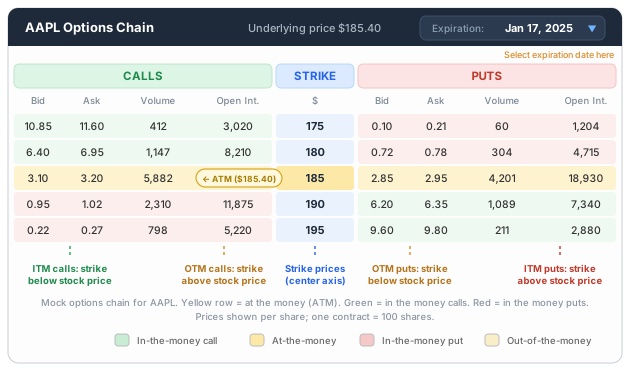
Mock options chain for AAPL showing calls (left), strike prices (center), and puts (right). Yellow row = at-the-money. Green = in-the-money calls. Red = in-the-money puts.
Here is the basic structure. The center column lists strike prices, the prices at which the underlying option contract can be exercised. To the left of center, you typically see call options. To the right, put options. At the top of the chain, you select an expiration date, which filters the entire view to show only options expiring on that date.
For a stock trading at $50, you might see strike prices listed at $45, $47.50, $50, $52.50, $55, and so on, stepping up and down in regular intervals. Each row represents a different option with its own price, its own risk profile, and its own behavior.
A few columns appear in every options chain regardless of which broker you use: The bid price (what buyers are currently offering), the ask price (what sellers are currently demanding), the last traded price, volume for the day, and open interest (the number of contracts currently outstanding). These numbers tell you how actively a particular option is being traded.
The options chain is the map of everything available to you at any given moment. How to read it in full detail, column by column, is a subject that warrants its own guide. What matters at this stage is recognizing that the chain is organized around two axes: Strike prices on one axis and expiration dates on the other. Every option you will ever trade lives at the intersection of those two coordinates.
Having the ability to pull comprehensive data from the option chain can be very informative in making trading decisions. For instance, at Geeks Of Finance, an option flow tool exists that highlights specific strikes and their associated expirations that are experiencing unusual volume and changes in open interest. The dynamic nature of this live environment can show where large players are positioning in anticipation of future moves.
Understanding Options Expiration
Every option has an expiration date printed right on it. On that date, the option either has value or it does not, and the decision about what to do is no longer yours to delay.
Most standard options expire on the third Friday of each month. In recent years, weekly options have expanded dramatically, and there are now options expiring every day of the week on major stocks and ETFs. The rise of zero-days-to-expiration options, known as 0DTE, has become one of the most significant structural shifts in the options market. But for a beginning options investor, the monthly expiration cycle is the right frame to start with.
How Options Expiration Cycles Work: Weekly vs. Monthly vs. LEAPS
Two terms that come up constantly in the context of expiration are in the money and out of the money. These describe where an option stands relative to the current price of the underlying stock.
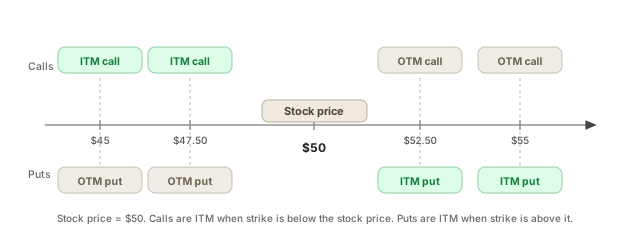
With the stock at $50, calls at $45 and $47.50 are in the money; calls at $52.50 and $55 are out of the money. The reverse is true for puts.
A call option is in the money when the stock price is above the strike price. If you hold a call with a $50 strike and the stock is trading at $55, that option has $5 of real, intrinsic value. You have the right to buy at $50 what is currently worth $55.
A put option is in the money when the stock price is below the strike price. A put with a $50 strike on a stock trading at $44 has $6 of intrinsic value.
Options that are out of the money have no intrinsic value. A call with a $55 strike on a stock trading at $50 is out of the money by $5.
At expiration, three outcomes are possible depending on where the option stands:
- Expires worthless. If your option is out of the money at expiration and you take no action, it expires with a value of zero. The premium you paid is gone.
- Gets exercised. If your option is in the money at expiration, you can exercise it and collect the intrinsic value. Many brokers will automatically exercise in-the-money options at expiration if the difference exceeds a threshold (typically $0.01 per share). Check your broker's policy.
- Gets sold before expiration. This is by far the most common outcome. You close the position while it still has value. The next section explains why this is usually the right move.
How Exercise and Assignment Work
Exercise is the act of using your option. As the buyer of a call, exercising means you are choosing to buy 100 shares of the underlying stock at the strike price. As the buyer of a put, exercising means you are choosing to sell 100 shares at the strike price.
The mechanics differ depending on whether you are holding a call or a put, and the mirror image of exercise is assignment. Assignment is what happens to the seller when the buyer exercises.
| CALL OPTION | PUT OPTION | |
|---|---|---|
| When you exercise | You buy 100 shares at the strike price, regardless of the current market price. | You sell 100 shares at the strike price, regardless of the current market price. |
| Makes sense when | Stock price is above the strike price (you are in the money). | Stock price is below the strike price (you are in the money). |
| What assignment means for the seller | The call seller must deliver 100 shares at the strike price. | The put seller must purchase 100 shares at the strike price. |
Here is what exercise looks like in practice. You hold a call with a $50 strike on a stock trading at $58. You decide to exercise. Your broker purchases 100 shares at $50 each, costing you $5,000. You now own those shares at a cost basis of $50, even though the market price is $58. The $8 gap is your gain, before commissions.
Assignment is exercise's mirror image. If you sold a call with a $50 strike and the buyer exercises it, you are obligated to deliver 100 shares at $50, regardless of what the stock is trading at. Assignment is why selling options carries obligations that buying options does not.
Understanding Options Assignment
Most U.S. equity options are American-style, meaning they can be exercised at any time before expiration, not just on the expiration date itself. European-style options, more common in index products, can only be exercised at expiration. For most individual stocks and ETFs you will encounter at the start, assume American-style.
Let’s look at a general example that occurs occasionally in one of the Geeks Of Finance weekly income strategies: We sell an out-of-the-money put option on GLD expiring in 3 days with the goal of collecting income. One day prior to expiration, GLD declines below our strike price, causing an assignment of GLD units (shares) at the strike price of our put option. We still keep the income collected in the form of the premium received, and our risk profile does not change, except that we now have 100 units (shares) that we can either keep or sell.
Why Most Options Never Get Exercised
Here is something that surprises most beginners: The vast majority of options traders never exercise their options. They sell them instead.
This is not a loophole. It is the intended use of the instrument. When you sell an option before expiration, you capture whatever value is left in it, including both intrinsic value and the time value that has not yet decayed away. Exercising strips out the time value and leaves you with only intrinsic value. Selling captures both.
An example. You bought a call for $2.00 per share ($200 per contract). The stock moved in your direction. Your call is now worth $4.50. You have two choices: Exercise and receive the intrinsic value mechanically, or sell the contract for $4.50 and receive $450. In most cases, selling is the right answer because it captures the full value of the position.
Options trading is, in practice, much more like trading a security than it is like executing a contract. You open a position, you watch it move, and you close it by selling. The exercise mechanic exists and matters in certain situations, but it is not the primary path for most retail options traders.
Understanding this changes how you should think about the options chain. You are not looking at a menu of contracts you might someday exercise. You are looking at a market of securities you can buy and sell, each with a defined expiration clock, at prices that move in real time based on the underlying stock, the time remaining, and a handful of other factors we will examine closely in the next course.
At Geeks of Finance, the Options Flow feed captures exactly this activity in real time: The buys and sells as institutional traders open and close positions, with size and intent visible in ways that are not available anywhere in the options chain itself. The Geeks combine activity on the option chain with gamma exposure (GEX) data to decide which contracts they want to buy, using call or put debit spreads to anticipate a directional move without the intent of exercising. How do we decide whether or not the option we’re looking at is trading at a “good” price to enter the trade? What do we expect if the underlying stock goes our way? We’ll look at these questions and more related to options pricing in the next section.
What Is Options Flow and Why Do Institutional Traders Watch It?
What Comes Next
Market mechanics are the foundation. You now know how options are bought and sold, how to find and read an options chain, what expiration means in practice, and why most traders close their positions rather than exercise them.
What you do not yet know is what makes one option worth $1.50 and another worth $8.00. Why does the same call option behave completely differently on a calm day versus a volatile one? Why does the value of an option shrink as expiration approaches even if the stock price has not moved?
Those questions are pricing questions, and they are the subject of Course 2: Options Pricing and the Greeks. The Greeks are the variables that drive every option's price, and understanding them is what separates investors who use options with precision from those who use them and wonder why the results keep surprising them.
Options Pricing: The Greeks (Overview)
If you want to see everything covered in this lesson in a live environment before moving on, the GOF platform gives you access to real options chains across 700+ stocks and ETFs alongside the flow data that shows you how institutional traders are actually using them. A seven-day trial is $1.