


Your friend just told you that he made a killing trading options. Cool … but what exactly is an option?
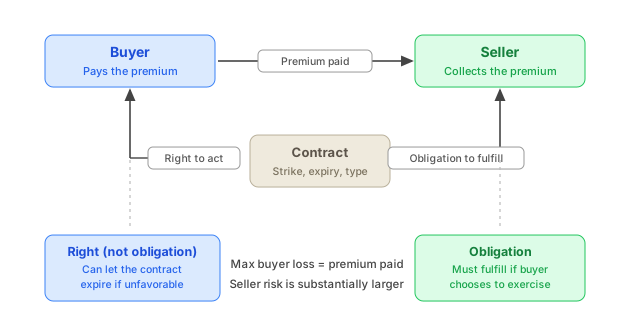
An option is a contract that gives the buyer the right but not the obligation to buy or sell a stock at a specific price before a specific date. The buyer pays a fee called the premium for that right. The seller collects the premium and takes on the obligation to fulfill the contract if the buyer chooses to act.
The Geeks dig into some pretty creative ways to hedge risk, gain asymmetric exposure to directional moves, and maximize gains when the market isn’t moving much at all, but first we need to start with the options basics.
What Is an Option?
Let’s start with what makes options different from stocks. When you buy a share of stock, you own a piece of a company. When you buy an option, you own a contract: A temporary agreement that gives you a specific right tied to that stock's price.
That right has two defining features. First, it lets you buy or sell the stock at a price locked in today, regardless of where the stock moves between now and expiration. Second, it comes with a deadline. The contract expires on a set date, and if you have not acted by then, it becomes worthless. Both features matter: The locked-in price is where the value comes from, and the deadline is where most of the risk lives.
The phrase "right but not the obligation" does a lot of work in any definition of an option. It means you are never forced to act. If the contract does not work in your favor, you can let it expire. Your maximum loss as a buyer is the premium you paid to enter the contract, full stop. That is a fundamentally different risk structure from owning a stock, where losses are theoretically the full amount you paid to buy the stock.
That premium (the price of the options contract itself) has two components worth knowing at this stage. Part of it is intrinsic value, which reflects whether the option is already profitable based on where the stock is trading right now. The rest is extrinsic value, which reflects time remaining, how volatile the stock is, and how far the market thinks it might move before expiration. We will explore both intrinsic and extrinsic value elsewhere. For now, understanding that the premium has two distinct parts explains something that confuses a lot of new options traders: Why an option can lose value even when the stock moves in the right direction.
Calls and Puts: The Two Types of Options Basics
Every option is either a call or a put. That single distinction determines everything about how the contract behaves, who profits, and under what conditions.
Call Options
A call option gives the buyer the right to purchase the underlying stock at the strike price before expiration. Call buyers are betting the stock will go up. If the stock rises above the strike price, the call gains value in two ways: The buyer can exercise it and purchase the stock at a below-market price, or the buyer can sell the contract itself to another trader at a profit without ever touching the stock.
A simple way to think about it: Imagine you find a house you want to buy for $400,000, but you are not ready to commit yet. You pay the seller $5,000 for the right to buy that house at $400,000 any time in the next 90 days. If the house's value jumps to $450,000, you can exercise your right and buy it at the agreed-upon $400,000, or sell your contract to someone else for a profit. If the value drops, you let the contract expire worthless. The most you lose is the $5,000 you paid. Call options work exactly the same way.
Put Options
A put option gives the buyer the right to sell the underlying stock at the strike price before expiration. Put buyers are betting the stock will go down. If the stock falls below the strike price, the put gains value, because the holder can sell shares at a price higher than the current market rate.
Put options are the reason sophisticated investors rarely sell a stock just because they expect a short-term drop. If you own 500 shares of a stock trading at $80 and you are worried about an earnings report next week, buying a put at the $75 strike costs you only the premium. If the stock falls to $60, your put gains substantial value and offsets a large portion of the loss on your shares. If the stock holds or rises, the put expires worthless and you keep your position intact. In this example, options are a form of insurance protection as opposed to speculation.
| Call Option | Put Option | Why It Matters | |
|---|---|---|---|
| What it gives you | Right to buy | Right to sell | Defines your position |
| You profit when... | Price goes up | Price goes down | Determines direction |
| Typical use | Bullish bets, income (selling) | Bearish bets, hedging | Shapes strategy |
| Max loss (buyer) | Premium paid | Premium paid | Risk is defined |
What Are Options? (Calls vs. Puts)
Buyers and Sellers: Four Positions, Not Two
Most people learning options basics think of two positions: Buy a call or buy a put. There are actually four, because both calls and puts can be bought or sold. The buyer and seller are on opposite sides of the same contract, with fundamentally different obligations.
- Long call: You buy a call. You have the right to purchase the stock at the strike price. You profit if the stock rises above the strike.
- Short call: You sell a call. You collect the premium and take on the obligation to sell the stock at the strike price if the buyer exercises. You profit if the stock stays flat or falls.
- Long put: You buy a put. You have the right to sell the stock at the strike price. You profit if the stock falls below the strike.
- Short put: You sell a put. You collect the premium and take on the obligation to buy the stock at the strike price if the buyer exercises. You profit if the stock stays flat or rises.
The asymmetry here is worth understanding before you go any further. Buyers pay a premium and acquire a right. Sellers collect that premium upfront and accept an obligation in return. A buyer's maximum loss is capped at what they paid. A seller's maximum loss can be far larger, which is why selling options carries risks that buying options does not. Most beginners start on the buying side, and that is a reasonable place to start.
“Buyers have rights. Sellers have obligations. That asymmetry shapes every options trade.”
What Options Are Written On
Most options you will encounter as a retail investor are written on individual stocks or exchange-traded funds (ETFs). Options on major indexes like the S&P 500 (SPX) and the Nasdaq (NDX) are also widely traded. Index options behave somewhat differently from single-stock options, particularly around settlement and exercise mechanics, in ways that will become relevant as your understanding deepens.
Options also exist on futures contracts, commodities, and cryptocurrencies. Each of those markets has its own rules and quirks. This course focuses on equity options because that is where the foundational logic is clearest and where most retail investors begin.
One concept applies universally regardless of the underlying asset: An option derives its value from something else. If the stock does not move, an option can still lose value every day simply because time is passing and the window for the stock to move is shrinking. That relationship between option contract and underlying asset is what the rest of this course is built around.
How Options Expiration Cycles Work: Weekly vs. Monthly vs. LEAPS
Key Options Basics Terms You Will See in Every Discussion
Before going further, it helps to pin down a few terms that appear in nearly every options conversation. You will see all of them the moment you open a real options chain.
| TERM | WHAT IT MEANS |
|---|---|
| Premium | The price you pay (or collect) for an options contract. Think of it as the cost of the rights the contract gives you. |
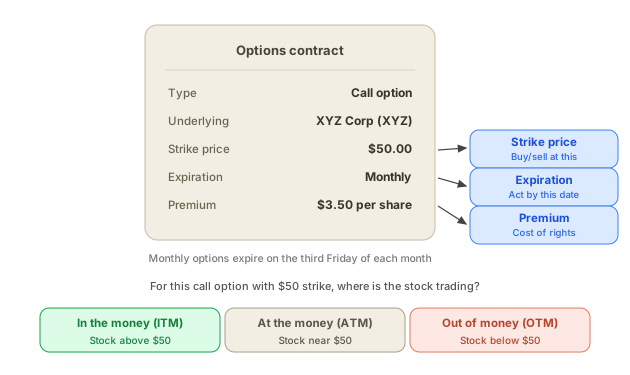
| Strike Price | The agreed-upon price at which you can buy or sell the underlying asset if you choose to exercise the option. |
| Expiration Date | The deadline by which you must act on your option. After this date, the contract expires and becomes worthless. |
| In the Money (ITM) | An option with intrinsic value. A call is ITM when the stock price is above the strike; a put is ITM when the stock price is below the strike. |
| At the Money (ATM) | An option whose strike price is roughly equal to the current stock price. |
| Out of the Money (OTM) | An option with no intrinsic value. A call is OTM when the stock price is below the strike; a put is OTM when the stock price is above the strike. |
Do not try to memorize these in isolation. They will click into place as soon as you start looking at a live options chain, which is exactly what the next lesson covers. Reading them as a list is a poor substitute for seeing them in context.
Why Options Exist and Why Retail Investors Use Them
Options were not created for retail traders. They evolved out of institutional needs, primarily the need for large funds to hedge against losses without liquidating positions. A fund managing a $500 million equity portfolio cannot sell everything every time it expects a rough quarter. The transaction costs alone would be prohibitive, and the selling pressure would move the market against them. Options gave institutional traders a way to buy downside protection while staying invested. That remains their primary function in professional portfolios today.
Retail investors use options for three main reasons:
- Hedging: Using puts to protect a stock position against downside risk, the same way institutions do.
- Directional speculation: Making leveraged bets on a stock's direction with a defined maximum loss equal to the premium paid.
- Income generation: Selling options to collect premium on stocks you already own or are willing to own.
Each of these uses we will cover in depth in elsewhere. For now, the important thing is recognizing that options are tools. How you use them determines whether they manage risk or create it.
One more thing worth knowing at this stage: The options market leaves a data trail. Every large institutional trade, every unusual position, shows up in options flow data in real time.
At Geeks of Finance, we track that data across 700+ stocks and ETFs to surface signals that most retail investors never see. That is not directly relevant to reading a basic options contract, but it is the reason options literacy matters beyond just trading options yourself.
Let’s look at a real-life example: On April 22, 2026, the Geeks posted in Discord that Rocket Lab (RKLB) was showing significant option flows in near-term calls between the $90-100 strikes for five consecutive trading sessions, while the stock was trading in the low $80s.
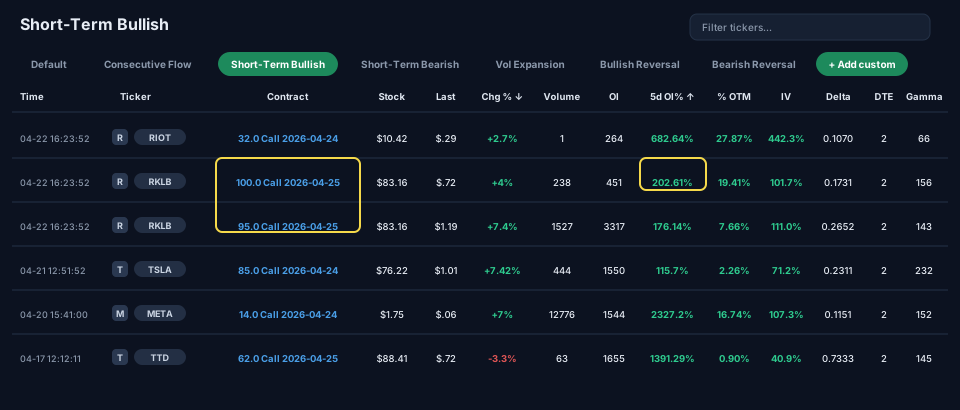
Fast forward to May 8: RKLB jumped 34% in one day, closing at $105.47. How do you like them apples?
What Is Options Flow and Why Do Institutional Traders Watch It?
What's Next in This Course
You now have the foundation: What an option is, the difference between calls and puts, the four positions you can hold, and the vocabulary you will need for every conversation that follows.
Hopefully you also have an anecdotal taste of the power options can provide in making money, even if simply observing options behavior gives you an informational edge in trading the underlying stock.
The next lesson moves into mechanics: How options are actually bought and sold, what an options chain looks like, and how expiration and exercise work in practice. The Geeks hope you’ll focus on internalizing the concepts we’re about to cover, and we believe your understanding will really start to come together as we look at some real examples as well.
Up next: Foundations of Options: Market Mechanics (Course 1, Lesson 2).